 Ray the RV
The wheel that left
I once watched a wheel come off a fifth wheel on the interstate. Nobody was hurt. What stayed with me was how many earlier checks could have caught it: lug torque, bearing play, grease leaks, a hub running hot.
For trailer, fifth-wheel and motorhome owners
I've lived full time in a 31-foot travel trailer for eleven years, with no service school and no dealership counter. Here's how I learned to catch trouble while it's still a $12 fix. Watch this first:
The part nobody tells you
A soft floor beside the shower doesn't begin as a soft floor. It begins as a cracked bead of sealant, a loose fitting, or a drain that moves a little every time somebody steps into the pan. Water slips in where nobody can wipe it up. The plywood stays damp. Months later, a foot finds the damage.
The rest of the rig works the same way:
Once you can see the chain, you can break it early. That's what this manual teaches.
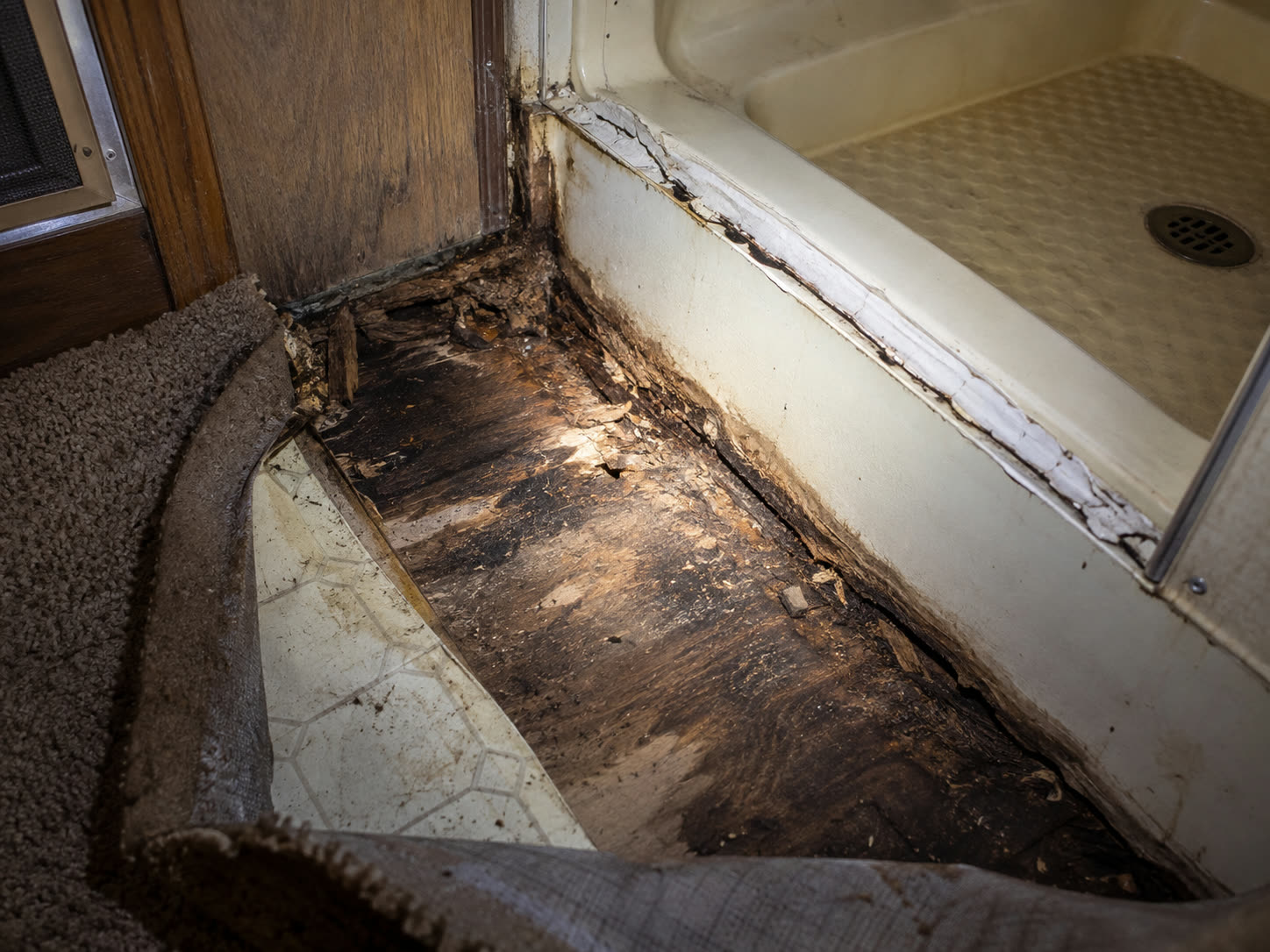
A cracked sealant bead, a few seasons later. A $12 tube would have stopped it.
Diagnose before you buy parts
Swapping parts on suspicion feels like progress. Usually it just means you now own a new part and still have the same problem.
| The symptom | What people buy | What it often turns out to be |
|---|---|---|
| Water pump went quiet | New pump, $80–$180 | A $1 fuse, a loose crimp, an empty tank, or a bumped switch |
| Furnace or water heater quits after rain | Control board, ~$200 | Water getting in at the opening. A $12 tube of the right sealant |
| "New board fixed it... for a day" | $150 circuit board | A corroded connector that got wiggled during the install |
| Refrigerator cooling weak in summer | Cooling unit, $900–$2,000 installed | A mud dauber nest blocking the vent airflow |
| Something "just stopped working" | Mobile tech, $125–$250 before parts | A 12-volt problem a $20–$50 multimeter would have found |
Price ranges are the ones Ray quotes in the book. Your costs will vary by rig and location.
What's inside · 12 chapters · 169 pages
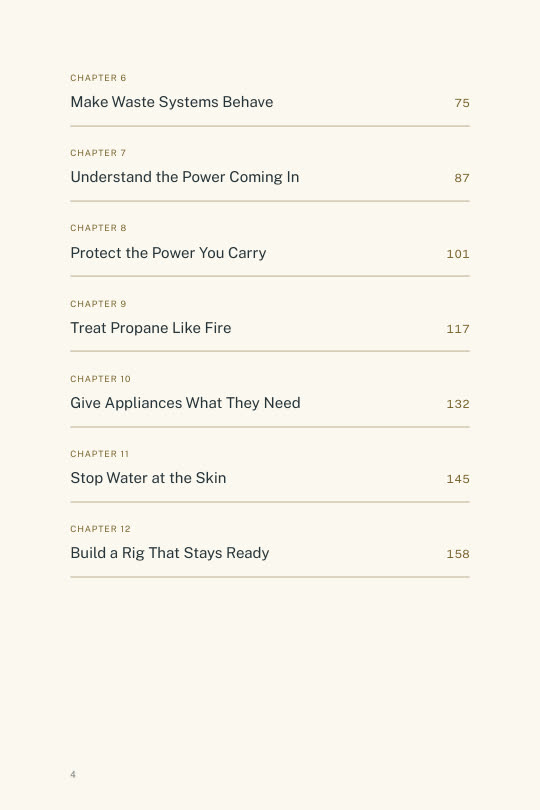
Written in plain words, with 40+ diagrams and checklists. Each chapter follows the failure backward to its cause, and tells you what to check before you spend a dime.
The six connected systems in every RV, and how one small failure travels into the next. Plus how to build a baseline record of "normal" before trouble starts.
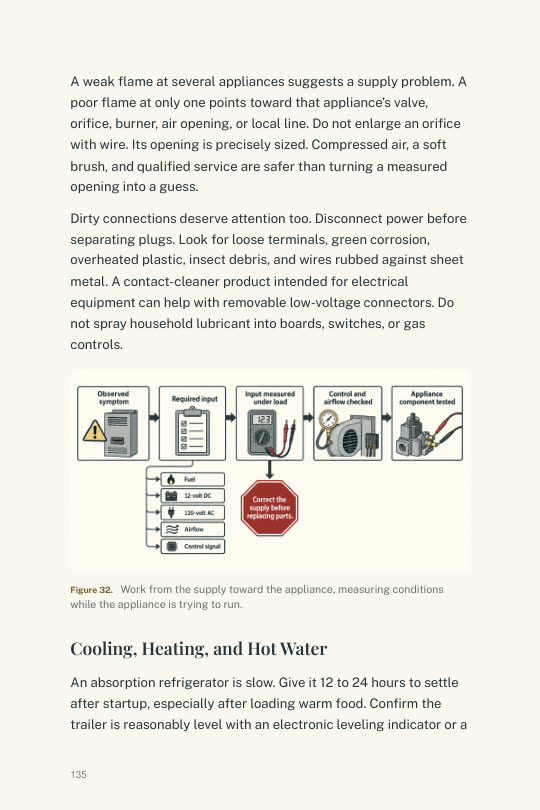
Turn "the furnace is bad" into observations you can actually test. Follow the failure backward with a meter, a gauge and a flashlight.
Leveling at the wheels, real chocks, supports that don't twist the frame, and hookups with no strain on your utilities.
Tires, lug torque, bearings, brakes and suspension. The small warnings that come before a roadside failure.
Fresh-water pressure, pumps, check valves and hidden leaks. Why a pump that cycles on its own is telling you something.
Traps, vents, valves and tank sensors. Odors, gurgles, sticky blades and false "full" readings, and what actually fixes them.
Shore power, pedestals, cords, GFCIs and the 120-volt side, explained so you can measure instead of guess.
Batteries, converters, fuses and the 12-volt system that quietly runs your furnace, fridge controls and slides.
Cylinders, regulators, leak checks done the right way, and alarms that beep but are past their service date.
Refrigerator, furnace, water heater and A/C: the sequence each one follows, and where that sequence usually breaks.
Roof, sealants, seams, windows and slide openings. Read the roof before it leaks, and pick the sealant that's compatible.
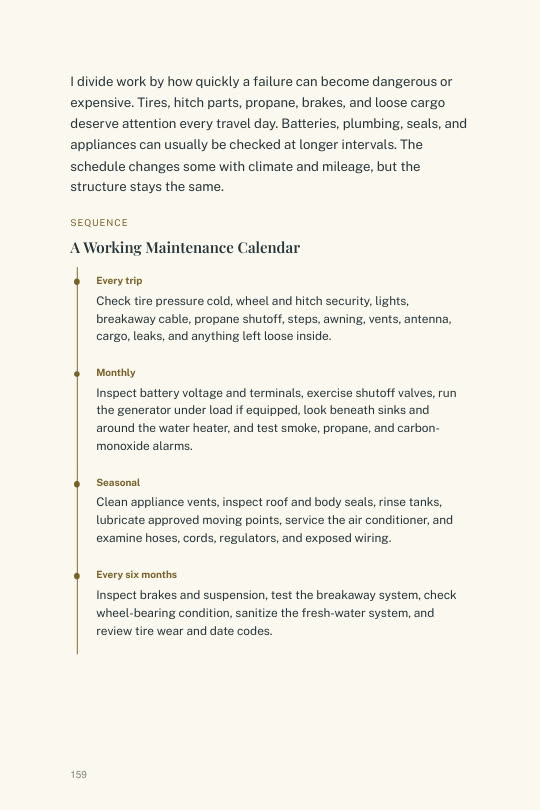
Seasonal routines, storage, spares and records, so the next failure finds you prepared and not stuck.
Who it's for

Twice a year, and after every hard storm: read the roof before it leaks.
From the author
The book is full of short stories from the road. Each one ended with a new habit.
I once watched a wheel come off a fifth wheel on the interstate. Nobody was hurt. What stayed with me was how many earlier checks could have caught it: lug torque, bearing play, grease leaks, a hub running hot.
I went three seasons without screens on the fridge vents because nothing had bothered them yet. Then cooling faded, and behind the fridge was a mud dauber nest the size of my fist. That cheap delay could have cost me a cooling unit.
My first season I relied only on X-chocks and forgot the real wheel chocks, on a site next to a neighbor's fence. Nothing happened, but seeing that fence cured the habit for good.
I pulled into a campground during a power outage. The pedestal was dead, which I expected. The well pump was dead too, which I didn't. Now I carry five to ten gallons on every travel day.
Look inside
No fluff and no fifty pages of "about me". Every page is something you can use at your own rig.
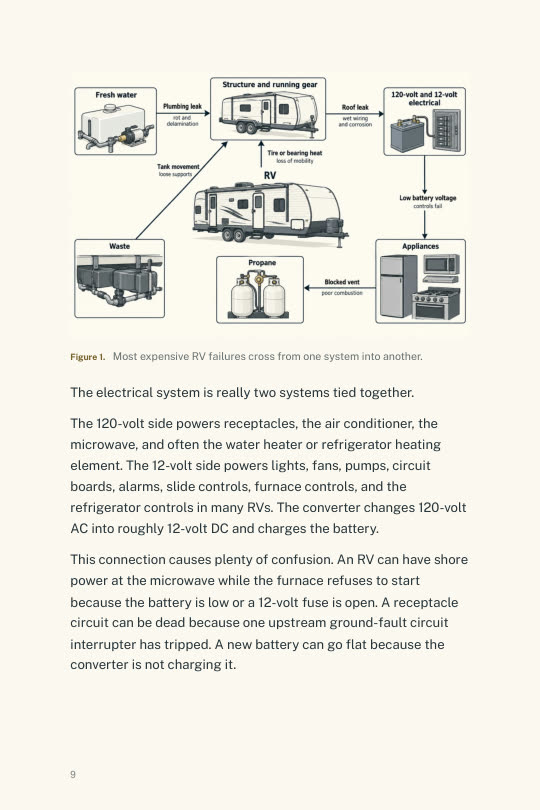
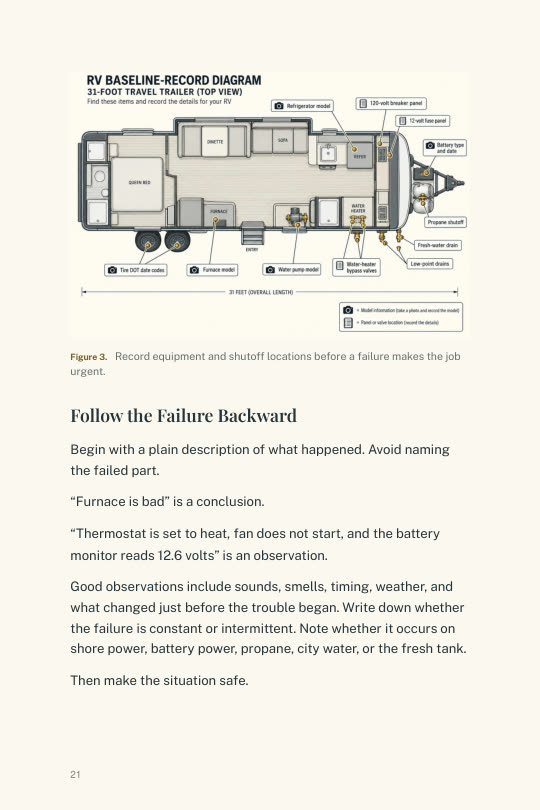
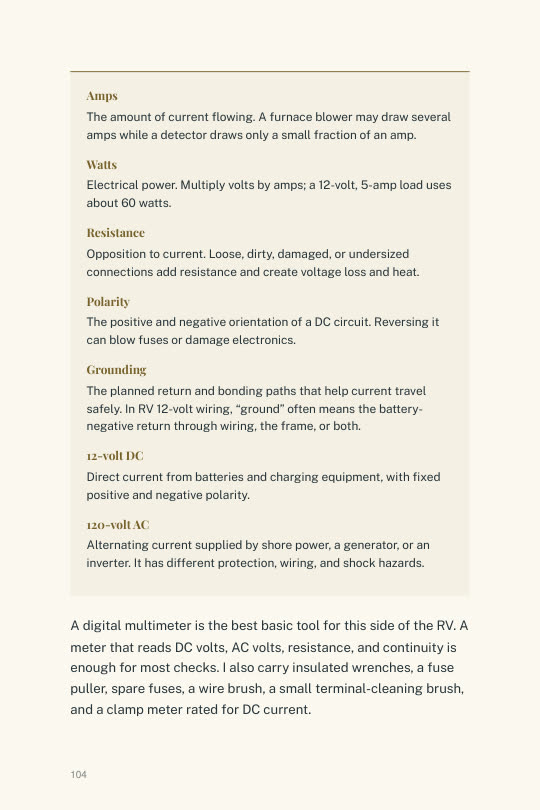

About the author
I sold my house and moved into a 31-foot travel trailer eleven years ago. I never went to service school, and I never worked a dealership counter. What I know came from things failing a long way from help.
At first I changed parts whenever I got worried. That got expensive. Over time I learned to stop, look at the symptom, trace what fed the part that failed, and check the cause with a meter, a gauge, a light or a careful look.
I still fix things twice sometimes. The second repair usually teaches me what I forgot to check before the first. This manual is everything those second repairs taught me, so you can skip a few of them.
Get the manual today
A single mobile tech visit runs $125–$250 before parts. The whole manual costs $26, once.

The Practical RV Systems, Maintenance, Failure and Repair Manual
Email us within 30 days of purchase and you'll get a full refund. No forms and no hard questions. That's how I'd want to be treated.
Questions
No. It's a digital PDF (169 pages), so there's nothing to ship and you can start reading within a minute of paying. You can print it if you want a copy for the rig.
Right after payment you're taken to the download page, and we also email you a link at the address you used at checkout. If the email doesn't arrive, check your spam folder, or write to nikolasleszczak@gmail.com.
The book is about the systems every RV has: running gear, fresh water, waste, 120-volt and 12-volt power, propane, appliances and the outer skin. It was written from a travel trailer, and the same principles apply to fifth wheels and motorhomes. It's not a make-and-model shop manual.
No. It's written in plain words, with "In Plain Words" boxes that explain every term. If you can read a multimeter or are willing to learn (the book shows you how), you'll be fine. It also tells you clearly when a job belongs to a qualified technician.
No. You pay $26 once. There are no recurring charges.
The price is $26 USD. Buyers in the EU, UK and a few other countries are charged VAT at their local rate on top, and it is shown in the checkout before you pay. US buyers pay $26.
Email nikolasleszczak@gmail.com within 30 days of purchase and you'll get a full refund. See the refund policy.
Yes. Payments are processed by Whop, a PCI-compliant payment platform. We never see or store your card details.